




Production targets may be measured in tonnes, current efficiency and cost per tonne, but performance is often won or lost at thousands of small, repeated interfaces.
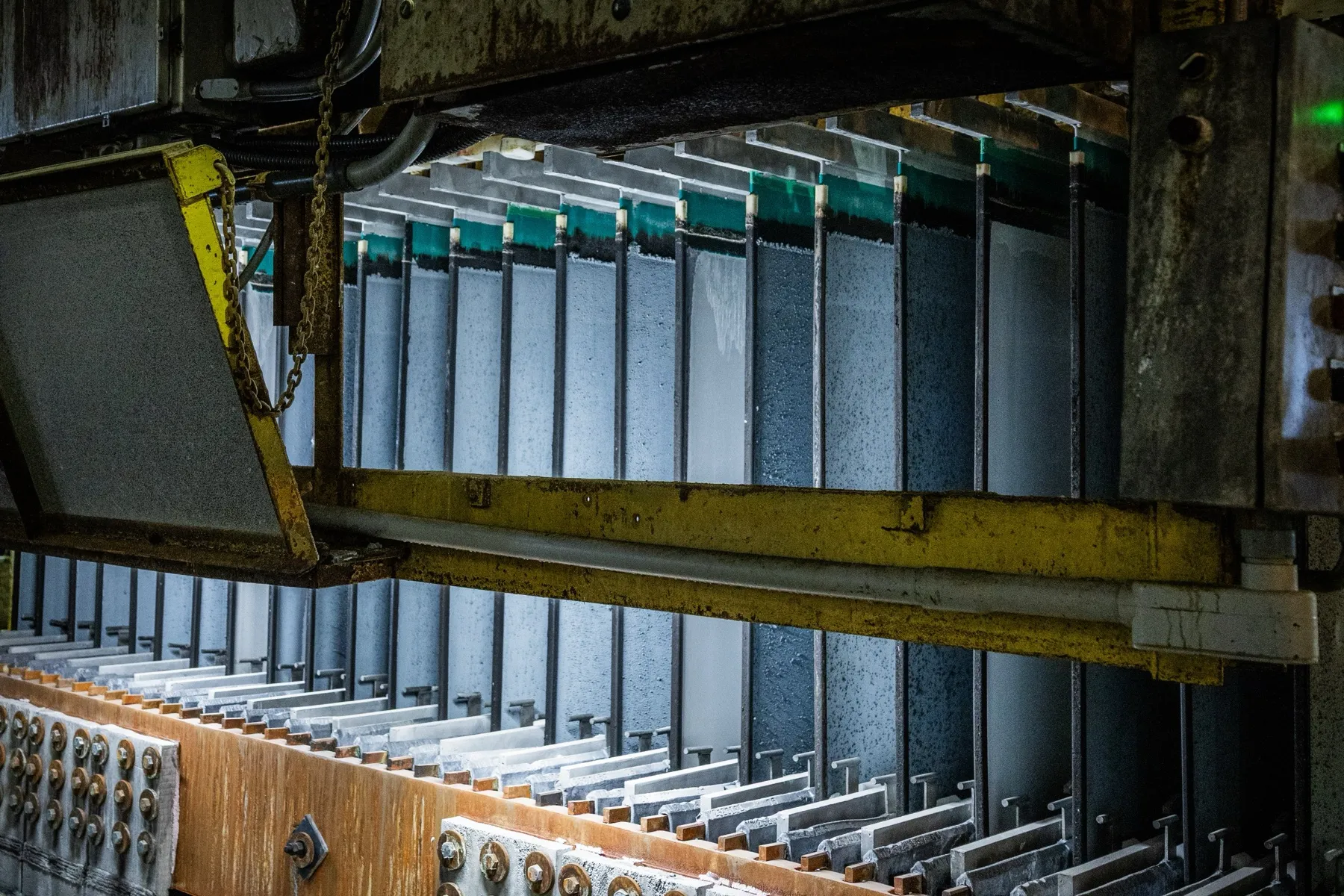
The cathode is part of an operating system
In electrowinning and electrorefining, a cathode is not simply a stainless steel plate. It is an electrical conductor, a mechanical tool and a repeatedly handled production asset. It must hang correctly, receive current consistently, present a suitable deposition surface, move through material-handling systems and release product reliably. Its performance depends on how well it functions within the entire cell house.
Electrical integrity
Every electrical interface matters—from busbar and contact points to the connection between the head bar and sheet. Unnecessary resistance can create voltage losses and localized heating, while inconsistent contact conditions can contribute to uneven current distribution across a cell. The operational consequence depends on the plant’s configuration: a rectifier-limited operation may lose production opportunity, while another plant may consume more power to maintain its target output. Reliable design must therefore consider both initial conductivity and how the electrical pathway changes with age, corrosion, handling and maintenance.
Geometry, alignment and current distribution
Straightness, flatness, vertical alignment and spacing influence deposition quality and the risk of short circuits. Small dimensional inconsistencies can become significant when multiplied across thousands of electrodes and many cells. Precision in fabrication, disciplined handling and early identification of distorted units all contribute to stable operation.
Stripping and handling
A cathode must also work with the plant’s stripping and material-handling systems. Surface condition, edge-strip performance, deposit release and structural rigidity can affect cycle time, manual intervention, equipment stoppages and damage. The best solution is not simply one that produces metal; it supports repeatable, safe and efficient processing throughout the operating cycle.
Lifecycle visibility
Cell houses often know the size of their cathode fleet but have limited information about the history of each asset. Identification, inspection standards and fleet tracking can reveal age profiles, repeated failure modes and refurbishment opportunities. Operators can then move from reactive replacement to risk-based fleet management.
Measure the system, not a single data point
Meaningful assessment combines electrical measurements, operating data and physical inspection. Useful indicators may include contact voltage drop, temperature, current distribution, shorts, stripping interruptions, repair frequency, rejection rate and production loss associated with damaged cathodes. The objective is to identify the constraint that has the greatest economic effect—not merely the defect that is easiest to see.
A practical innovation agenda
The most valuable cell house innovations frequently come from connecting disciplines: metallurgy, electrical performance, mechanical design, automation, maintenance and data. LIMPACT works with customers to understand those relationships and focus improvement efforts where they can produce durable operating value.
“A permanent cathode fleet is an operating system. When electrical, mechanical and handling requirements are engineered together, the cell house becomes more predictable.” — Jeremy Pertman, President, LIMPACT
Invite LIMPACT to help assess your cathode fleet, operating interfaces and improvement opportunities.